Severe tooth pain emergency has a way of arriving at the worst possible moment — the evening before a workday, the first night of a weekend — and it always asks the same question: is this an emergency, or can it wait?
This guide helps you answer that question honestly. It walks through what different pain patterns usually point to, the specific symptoms that mean “today, not next week,” what genuinely helps tonight, and what only masks a problem while it gets worse. It also names the symptoms that are not a dental visit at all, but a hospital one.
One thing to know before you start reading your symptoms: a pain pattern can point, but it can’t diagnose. Only an examination — usually with an X-ray — confirms what is happening inside a tooth. If your pain is severe, the fastest honest answer comes from an emergency dentist who can see you, not from any article. Use this guide to decide how fast to move, not to talk yourself out of moving.
Read Your Pain: What Different Pain Patterns Usually Point To
Different problems tend to hurt in different ways. These are the patterns dentists hear most often, and what they commonly mean — with the honest caveat that patterns overlap, and only an assessment confirms the cause. The Ontario Dental Association’s resources for patients cover dental symptoms and treatment in the same plain terms.
- A throbbing or aching pain that comes and goes, and feels worse lying down. This often points to inflammation inside the tooth (the pulp). It is a pattern that tends to escalate rather than settle.
- Pain that lingers after hot or cold food is gone. A sensitivity that fades in seconds is common and usually less urgent; sensitivity that stays for a minute or more after the source is removed often means the pulp is involved.
- A sharp pain when you bite down, or when you release the bite. This can point to a cracked tooth, or to a filling or crown that needs attention. A tooth that suddenly feels “high” or raised when you close your mouth deserves a prompt call.
- Dull, heavy aching in the upper back teeth, with congestion or a cold. The roots of the upper back teeth sit close to the sinuses, so sinus pressure can feel like tooth pain — and real tooth problems can hide in the same place. If it persists, it still needs a dental assessment to separate the two.
- Pain with swelling, a bad taste, or a pimple-like bump on the gum. These point toward infection, not just irritation — and infection changes the urgency completely (see the red-flag list below).
- Pain that woke you from sleep, or pain that painkillers barely touch. Whatever the cause turns out to be, pain at this level has already answered the triage question: be seen today.
The Red-Flag List — Pain That Means “Today, Not Next Week”
Call a dentist the same day — do not schedule these for next week:
- Swelling in the gum, cheek, face or jaw on the side of the pain
- Fever alongside tooth pain
- A bad taste in the mouth, or fluid draining from the gum near the tooth
- Pain when biting with a tooth that feels raised or loose
- Pain after an injury — a fall, a blow, a sports accident — even if the tooth looks intact
- Bleeding from the mouth that doesn’t stop with gentle pressure
- Pain that is getting worse day over day, or that over-the-counter relief no longer eases
Several of these are signs an infection may be spreading beyond the tooth. If you want the fuller picture of how that progression looks, read the signs a tooth infection has spread — and if any of the hospital-level symptoms below apply to you, skip the reading and go.
What Genuinely Helps Tonight (and What Only Masks a Worsening Problem)
If you are waiting hours — not days — for an appointment, these measures genuinely help:
- A cold compress on the cheek (a cold pack or bag of frozen vegetables wrapped in a cloth), on and off in short intervals. Do not put heat on a swollen face; warmth can make swelling worse.
- Keep your head raised. Lying flat increases blood flow to the head and can intensify throbbing — an extra pillow is a real, if small, help at night.
- Rinse gently with warm salt water and keep the area clean; soft food only, and chew on the other side.
- Over-the-counter pain relief, used exactly as directed — the next section covers using it safely.
And what only masks the problem, or makes it worse:
- Relying on painkillers for days while the cause progresses. Relief is not treatment; an infected tooth does not improve because it hurts less.
- Antibiotics from the medicine cabinet. Never start, share, or finish leftover antibiotics on your own. Antibiotics are prescribed only after an assessment, when infection is spreading or affecting the whole body — and even then, they never substitute for treating the source: drainage, root canal treatment, or extraction. A pill cannot repair a tooth.
- Waiting for the pain to “peak and pass.” Pain sometimes does fade — and the FAQ below explains why that can be the worst sign of all.
For the longer story of where an ignored toothache can lead, see what can happen if a toothache is left untreated.
Painkillers: Using Them Safely — and Why They Never Fix the Cause
Used properly, over-the-counter pain relievers are the bridge between tonight and your appointment. Used carelessly, they add a second problem:
- Follow the package directions exactly, including the maximum daily amount. More is not more relief — it is more risk, particularly for the liver and stomach.
- Check the ingredients of everything you take. Many cold, flu and pain products contain the same active ingredient (for example, acetaminophen); taking two of them together can push you past the safe daily amount without realising it.
- Never place an aspirin or any tablet directly against the gum or tooth. It does not help the tooth and it chemically burns the soft tissue — a classic home remedy that creates a new injury.
- Ask first if your situation is complicated. If you take prescription medication, are pregnant, or have liver, kidney, stomach or heart conditions, ask a pharmacist or clinician which option is safe for you before taking anything.
The honest limit, stated once and plainly: painkillers turn the volume down on a signal. They do not remove decay, drain an infection, repair a crack, or save a dying nerve. If pain severe enough to need them lasts beyond tonight, the cause is still there in the morning — and it needs a dentist, not a refill.
When Tooth Pain Is a Hospital Emergency, Not a Dental One
Some symptoms mean the problem has outgrown a dental office. Go to a hospital emergency department, or call 911, if you have:
- Difficulty breathing, or difficulty swallowing
- Facial swelling that is spreading toward the eye or down the neck, or swelling that is closing the eye
- Fever together with facial swelling
- An inability to open your mouth properly
- Bleeding that does not stop
- An injury to the jaw — a suspected fracture, or a jaw that won’t close properly
This is not a booking pitch in reverse; it is the honest triage answer. A dental infection that threatens breathing or spreads toward the eye or neck is a medical emergency first. Hospital teams stabilise the emergency, and dental treatment follows. Never soften this list to protect an appointment — if these symptoms are yours, the hospital is the right call, tonight.
What the Emergency Visit Will Actually Involve
Knowing what happens takes most of the fear out of calling. An emergency visit at Emergency Dental Office, Thornhill, works like this:
You call first. Call (905) 764-5399 and describe what you’re feeling — when it started, whether there is swelling, what makes it worse. The clinic is open seven days a week: Monday to Friday 10 AM–10 PM, Saturday 3 PM–10 PM, and Sunday 10 AM–8 PM. For a severe tooth pain emergency, a same-day emergency assessment is often possible; the team will confirm the earliest available time when you call — nothing is promised before you’re assessed, and that is deliberate, not a dodge.
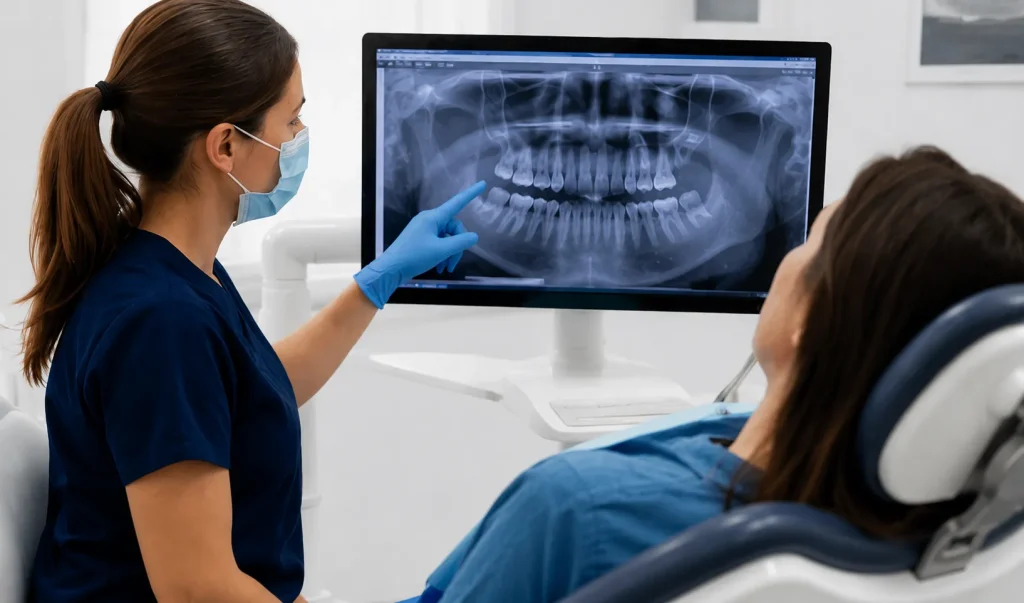
The assessment comes first. The dentist examines the tooth and the area around it and takes X-rays to see what the surface can’t show — the root, the bone, any infection. This is the step that turns a pain pattern into an actual diagnosis.
You hear the options before anything is done. Depending on what the assessment finds, treatment might mean a filling, root canal treatment to save the tooth, or — if the tooth cannot be saved — extraction. The dentist explains what each option involves and what it means for the tooth long-term, and treatment proceeds on your decision. If you’re anxious about being seen, say so when you call: the team will explain each step as they go and check your comfort throughout.
If your symptoms match the hospital list above, none of this applies — go there first. Otherwise, to book an emergency assessment, call (905) 764-5399 or use our contact page, and tell us the pain pattern you recognised in this guide — it genuinely helps the team triage your call.
References
The guidance in this article reflects Canadian dental practice and patient-education resources from the Ontario Dental Association, the Canadian Dental Association and the Royal College of Dental Surgeons of Ontario (RCDSO). Dentists in Ontario are licensed by the RCDSO, and patients can verify a dentist’s registration on the RCDSO website.
The triage guidance in this article — which symptoms can wait, which mean the same day, and which mean a hospital — reflects the patient guidance of the Ontario Dental Association and the Canadian Dental Association on dental pain and dental emergencies, and the standing principle in Canadian dental practice that antibiotics support, but never replace, treatment of the source of an infection.
Frequently Asked Questions About Severe Tooth Pain
Why does tooth pain get worse at night?
Mostly, position and attention. Lying flat increases blood flow to your head, which raises pressure inside an inflamed tooth and turns an ache into a throb; and at night there are no distractions competing with the signal, so the same pain feels louder. Pain that reliably wakes you is also a useful triage clue in itself — pain strong enough to break sleep has generally moved past the “watch it” stage, and it should be assessed promptly rather than endured night after night.
My pain stopped suddenly — does that mean it’s healed?
Often, the opposite. When pain from an infected or deeply decayed tooth stops abruptly, a common reason is that the nerve inside the tooth has died — the alarm has gone quiet because the tissue sending it is gone, not because the problem resolved. The infection that killed the nerve can continue spreading into the surrounding bone silently, without pain, until it surfaces as swelling, an abscess, or damage to neighbouring structures. Sudden silence after severe pain is a reason to be seen soon, not a reason to cancel.
Can I just take antibiotics for tooth pain?
Antibiotics are not a treatment for most tooth pain, and they are never a do-it-yourself one. A dentist prescribes them after an assessment when there are signs infection is spreading or affecting the whole body — fever, spreading swelling — as support alongside the real treatment. They cannot repair decay, drain a contained abscess, fix a crack, or save a dying nerve, because the source of the problem is inside or around the tooth and has to be treated directly: drainage, root canal treatment, or extraction. Never start, share, or finish leftover antibiotics from an earlier illness — the wrong drug, dose or course can mask symptoms while the source worsens, and it contributes to antibiotic resistance.
How long can I safely wait with a severe toothache?
If the pain is genuinely severe, the honest answer is: don’t measure the wait in days. Pain plus any red-flag symptom from this article — swelling, fever, a bad taste, pain on biting with a raised feeling — means the same day. Severe pain without those signs still deserves a call today, both because of what it usually indicates and because severe pain patterns tend to escalate, frequently at night. What should never happen is a severe toothache being carried for a week on painkillers: the causes of severe pain — deep decay, pulp inflammation, infection, cracks — do not heal on their own, and every one of them is easier and simpler to treat earlier.
Can a severe toothache go away on its own for good?
Pain can fade; the cause does not. Teeth have almost no ability to repair themselves — enamel doesn’t regrow, decay doesn’t reverse once it has cavitated, a crack doesn’t knit, and an infection inside a tooth has no blood supply route to clear itself once the pulp is involved. Toothaches that “went away” have usually changed form: the nerve died, the infection went quiet, or the pain threshold adapted. Each of those is a stage of the same problem, not the end of it — which is why a toothache that disappears still deserves an examination.
The pain is unbearable tonight — what should I do right now?
Start with the hospital check: difficulty breathing or swallowing, swelling spreading toward the eye or neck or closing the eye, fever with facial swelling, bleeding that won’t stop, or a jaw injury — any of those means a hospital emergency department or 911, now. If none of those apply: take over-the-counter pain relief exactly as the label directs, put a cold compress on your cheek, keep your head raised, rinse gently with warm salt water, and don’t chew on that side. Then call a dentist at the first opportunity — Emergency Dental Office is open seven days a week, evenings until 10 PM Monday to Saturday and until 8 PM on Sundays — and describe the pain as unbearable; that word correctly moves your call up the triage list.
Does severe tooth pain always mean the tooth has to come out?
No. Extraction is one possible outcome, not the default. What happens depends entirely on the cause the assessment finds: some painful teeth need a filling, many can be saved with root canal treatment, and extraction is the answer when a tooth is too damaged or too infected to save reliably. Any dentist who recommends removing a tooth should be able to explain why saving it isn’t the better option in your case — and that explanation only exists after an examination and X-rays, which is why the first visit is always an assessment, whatever the pain level.
I only have pain when I bite — no constant ache. Is that an emergency?
It’s a “book promptly” symptom rather than a middle-of-the-night one — with conditions. Pain on biting can come from a cracked tooth, inflammation around the root, or a filling or crown sitting too high; several of those worsen if the tooth keeps taking chewing force, and a crack in particular can extend from repairable to unsplittable. Book within days, chew on the other side meanwhile, and move it to same-day if the pain becomes constant, the tooth starts to feel raised or loose, or swelling or fever appears — those changes mean the situation has escalated.