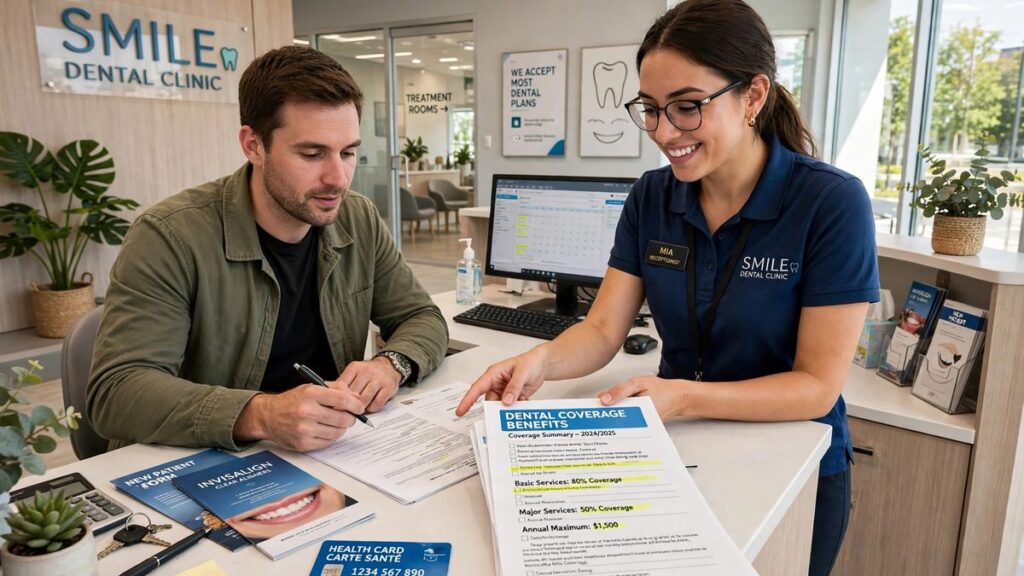
A dental emergency is stressful enough on its own. If you’re also counting on the Canadian Dental Care Plan — the CDCP — to help pay for it, a second worry arrives immediately: will any of this be covered?
The short answer is that emergency care is part of the CDCP for eligible members — emergency exams, X-rays, fillings, root canal treatment and extractions are all on the plan’s covered-services list. But “part of the plan” comes with conditions that matter at exactly the moment you’re in pain: you must already be an enrolled member with active coverage, the plan pays a share of its own established fees rather than automatically covering a clinic’s full fee, and a few big items — dental implants above all — are not covered at all.
This guide explains CDCP emergency dental coverage in plain language, before you need it: what the CDCP covers in an emergency, what it doesn’t, who qualifies, why the amount the plan pays may differ from the amount on the invoice, and the exact steps to get emergency care as a CDCP patient. Emergency Dental Office in Thornhill is an emergency dentist accepting CDCP patients — and this guide is written to be just as useful if your emergency visit happens somewhere else.
The Short Answer: Yes, Emergencies Are Part of the CDCP — With Conditions
The Canadian Dental Care Plan (Canada.ca) is the federal program that helps eligible Canadian residents — people with no access to dental insurance and a family income under a set limit — pay for part of the cost of dental care. Emergencies are not a special add-on to the plan; the core emergency services are part of its standard coverage for members.
Three conditions decide what that means for you in practice:
- You must be an enrolled member, with coverage already active. The plan covers care received on or after your coverage start date. An emergency that happens before your membership starts — or while you’re still waiting to be assessed for eligibility — is not covered retroactively.
- The service must be a CDCP-covered service, recommended by your provider. Most emergency care qualifies (next section). Some services need the plan’s preauthorization — approval before treatment — but the everyday emergency services generally do not.
- The plan pays a share, calculated its way. The CDCP pays a percentage of its own established fees for each service, which may not match the clinic’s fee. Depending on your income, you may pay a co-payment, and an additional charge is possible. The “Why Coverage May Not Equal the Full Fee” section explains this plainly — it is the part most patients get wrong.
Keep those three conditions in mind and the rest of this guide is detail. Forget them, and the plan can surprise you at the worst moment.
What the CDCP Covers in an Emergency
For the official list, see what the CDCP covers (Canada.ca). The services an emergency patient is most likely to need, in plain language:
- The emergency exam itself — complete, routine, specific and emergency exams are covered diagnostic services, along with X-rays to see what’s happening inside the tooth and bone.
- Fillings — permanent and temporary fillings, plus pain control for diseased teeth and other treatments for cavities: the first line when a broken or decayed tooth can be repaired.
- Root canal services — root canal treatments, pulpectomies (the first step of a root canal), and procedures to reduce infection and relieve pain, for teeth that are severely decayed, infected or broken.
- Treating infection — periodontal services include treating abscesses and cleaning under the gumline.
- Removal of teeth and roots — oral surgery services, for the tooth that cannot be saved.
- Surgical incisions, including draining — when an abscess needs to be drained as part of emergency care.
Two honest notes on this list. First, coverage applies when the service is recommended by an oral health provider — which is why the assessment comes first: the plan covers the treatment your examination shows you need. Second, some services beyond these — crowns are the common example — require preauthorization, meaning the plan confirms coverage before treatment begins, and not every request is approved.
What the CDCP Does Not Cover
Stated plainly, so an emergency never builds on a wrong assumption:
- Dental implants are NOT part of standard CDCP coverage. This matters in emergencies more than anywhere: if a tooth can’t be saved, its extraction is a covered service for eligible members — but replacing it with an implant afterward is a private expense. A covered replacement option may exist in some cases (complete dentures are covered services; partial dentures require preauthorization), and your dentist can explain which replacement paths are covered and which are private before you decide.
- Orthodontic services are currently not available under the CDCP — braces and clear aligners are not covered, emergency or otherwise.
- Cosmetic treatment is not covered — care is covered because it treats pain, infection or damage, not to improve appearance.
- Care received before your coverage start date is not covered — and neither is care outside the plan’s rules, such as services beyond its frequency limits without preauthorization.
Eligibility First: Who Qualifies — and Why the Assessment Comes Before Coverage Talk
To qualify for the CDCP, you must meet all four of these criteria:
- You have no access to dental insurance or coverage — none through your employer or a family member’s employer, none through a pension plan, and no private policy you bought yourself, not even the option to enrol in one. [One narrow exception exists for some retirees who opted out of pension dental benefits before December 11, 2023 and cannot opt back in — if that sounds like you, Service Canada can confirm how it applies.]
- Your adjusted family net income is less than $90,000 — the figure from your tax return, not your salary before deductions.
- You are a resident of Canada for tax purposes.
- You — and your spouse or common-law partner, if you have one — filed a tax return for the previous year, because the government confirms your income from it.
If you’re not a member yet, applications go through Service Canada (online through My Service Canada Account, or by phone) — that route starts on the Canada.ca page linked above. If you’ve already applied and want to know where it stands, you can check your CDCP application status — that guide walks through it.
Why does an emergency visit still start with an assessment, even for a confirmed member? Because coverage follows clinical need: the plan pays toward the services your examination shows you need, so the exam and X-rays come first, the treatment plan second, and the coverage confirmation for that plan third. That order protects you — it’s how you hear, before treatment begins, exactly which parts the plan will pay toward and what, if anything, you would pay yourself.
Why Coverage May Not Equal the Full Fee
This is the section to read twice, because it’s where CDCP expectations most often go wrong:
- The plan pays a percentage of its own fees, not the clinic’s. Under the CDCP fee guide, what the plan covers depends on your adjusted family net income: at the lowest incomes the plan covers 100% of its established fees (a 0% co-payment); in the middle band it covers 60% (you pay 40%); and in the highest band under the $90,000 threshold it covers 40% (you pay 60%). [The bands: lowest = under $70,000; middle = $70,000–$79,999; highest = $80,000–$89,999.]
- CDCP fees are not the same as clinic fees. If the clinic’s fee for a service is higher than the CDCP’s established fee for it, there may be an additional charge on top of any co-payment. That amount must be explained to you before treatment — if it isn’t, ask.
- You should never be asked to pay the full cost of a covered service up front and claim it back. Enrolled providers bill Sun Life (the plan’s administrator) directly for the covered portion; the plan reimburses providers, not patients. What you pay at the visit is your co-payment and any additional charge you agreed to — nothing more.
None of this makes the CDCP a bad deal — for eligible patients it removes most of the cost barrier to emergency care. It just means “covered” is a calculation, not a slogan, and the calculation for your mouth happens at your assessment.
How to Get Emergency Care as a CDCP Patient, Step by Step
Step 1 — Safety before paperwork. If you have difficulty breathing or swallowing, facial swelling spreading toward the eye or neck, fever with swelling, bleeding that won’t stop, or a jaw injury, go to a hospital emergency department or call 911. That is a medical emergency; coverage questions are sorted out after you are safe, never before.
Step 2 — Call the clinic and say you’re a CDCP member (or applicant). Emergency Dental Office accepts CDCP patients. Call (905) 764-5399 and describe the problem — the clinic is open seven days a week: Monday to Friday 10 AM–10 PM, Saturday 3 PM–10 PM, and Sunday 10 AM–8 PM. For urgent problems, same-day appointments are often available; the team will confirm the earliest time when you call.
Step 3 — Bring your member information and photo ID. Your member ID (from your determination letter or welcome package — the ID is what matters if the physical card hasn’t arrived) lets the team confirm your coverage and start date with Sun Life.
Step 4 — Assessment first. The dentist examines you and takes X-rays. This establishes what treatment you actually need — the thing coverage is calculated on.
Step 5 — Hear the coverage picture before treatment. The team confirms which parts of your plan are CDCP-covered services, whether anything needs preauthorization, and what — if anything — you would pay (co-payment, possible additional charges). Nothing proceeds on a guess.
Step 6 — Treatment, with the plan billed directly. The covered portion is billed to Sun Life by the clinic; you pay only the amounts explained in Step 5.

One maintenance note: CDCP membership is confirmed annually — if your emergency falls in a new benefit period, your coverage must have been renewed to be active. If you’re unsure whether yours is current, how CDCP renewal works explains the yearly routine.
To book an emergency assessment as a CDCP patient in Thornhill, call (905) 764-5399 or use our contact page — tell us you’re a CDCP member when you call, and bring your member ID and photo identification to the visit.
References
The guidance in this article reflects Canadian dental practice and patient-education resources from the Ontario Dental Association, the Canadian Dental Association and the Royal College of Dental Surgeons of Ontario (RCDSO). Dentists in Ontario are licensed by the RCDSO, and patients can verify a dentist’s registration on the RCDSO website.
Program details, eligibility criteria and coverage information are from the Government of Canada’s Canadian Dental Care Plan pages (Canada.ca), including the CDCP coverage page linked throughout this article. CDCP rules can change; if anything here differs from Canada.ca, Canada.ca is correct.
Frequently Asked Questions About CDCP Emergency Coverage
I have a toothache and no insurance — could the CDCP help me?
Possibly — “no insurance” is the first of the plan’s four criteria, and a toothache is exactly the kind of problem the plan’s covered services address. To qualify, you must also have an adjusted family net income of less than $90,000, be a resident of Canada for tax purposes, and have filed last year’s tax return (your spouse or common-law partner as well, if you have one). If you meet all four, you apply through Service Canada; once you’re enrolled and your coverage start date has arrived, emergency exams, X-rays, fillings, root canal treatment and extractions are covered services, with the plan paying a percentage of its established fees based on your income. One honest caution: enrolment is not instant and coverage is not retroactive, so if you’re in pain now, be seen now — don’t wait for paperwork while an infection progresses.
Does the CDCP cover emergency tooth extractions?
Yes — removal of teeth and roots is a covered oral surgery service under the CDCP for eligible members, and it is one of the most common emergency treatments the plan pays toward. As with every covered service, two things apply: your dentist first assesses and confirms the tooth can’t be saved (coverage follows the clinical need), and the plan pays its percentage of the CDCP established fee for the extraction, which may leave a co-payment and possibly an additional charge depending on your income band and the clinic’s fee — both explained to you before treatment. What the plan does not cover is the implant that might later replace the extracted tooth; that part is private.
My family income is under $90,000 but I have some coverage through work — do I qualify?
Almost certainly not — and it’s better to hear it plainly. The first eligibility criterion is having no access to dental insurance, and access counts even if you never enrolled, never use it, or consider it too limited to matter: a plan available through your employer, a family member’s employer, or a pension generally makes you ineligible regardless of your income. One narrow exception exists for some retirees who opted out of pension dental benefits before December 11, 2023 and cannot opt back in. If your situation is unusual, Service Canada — not a dental clinic — makes the eligibility call, and they’re the right place to confirm it.
Do I need to be approved before I can be seen for an emergency?
Two different approvals get mixed up here. To be seen, no — any dental clinic can assess you in an emergency, CDCP member or not, and hospital-level emergencies (trouble breathing or swallowing, spreading swelling, fever with swelling, uncontrolled bleeding, jaw injury) should never wait for any paperwork at all. To have the plan pay, yes: you must already be an enrolled CDCP member with an active coverage start date on or before the day of care, because the plan doesn’t cover treatment received before membership begins. Separately, a few covered services need the plan’s preauthorization before treatment — but the core emergency services (emergency exam, X-rays, fillings, root canal treatment, extractions) are standard covered services, so an emergency visit itself is not held up by preauthorization.
Does the CDCP cover a root canal for an infected tooth?
Yes — root canal treatment is a covered endodontic service under the CDCP, including pulpectomies (the first step of the treatment) and procedures to reduce infection and relieve pain. For an eligible member with active coverage, an infected tooth that can be saved is one of the clearest emergency uses of the plan. The same mechanics apply as everywhere in this guide: your dentist assesses and recommends the treatment, the plan pays its percentage of the CDCP established fee for it, and any co-payment or additional charge is explained before treatment begins. (Re-treatment of a previously completed root canal is the exception to note — that one requires preauthorization.)
Will I have to pay anything at an emergency visit as a CDCP member?
Possibly — it depends on your income band and the clinic’s fees, and anyone who promises you a definite “nothing” in advance isn’t being straight with you. The plan covers 100% of its established fees at the lowest adjusted family net incomes (no co-payment), 60% in the middle band (you pay 40%), and 40% in the highest band under the $90,000 threshold (you pay 60%). If the clinic’s fee for a service exceeds the CDCP’s established fee, an additional charge may apply on top. What you should never face is a surprise: the clinic explains your share before treatment begins, bills Sun Life directly for the covered portion, and you pay only the co-payment and any additional charge you agreed to.
If my tooth can’t be saved, does the CDCP cover an implant to replace it?
No. Dental implants are not part of the standard CDCP coverage — not when they’re planned, and not when the need arises from an emergency extraction. The extraction itself is a covered service for eligible members; the implant that might replace the tooth afterward is a private expense, to be planned and budgeted separately. Depending on your situation, a covered replacement path may exist — complete dentures are covered services, and partial dentures are covered with preauthorization — and your dentist can walk you through which replacement options are covered and which are private before you commit to any of them.
I’m not a CDCP member yet — can I apply now and use it for this emergency?
You can apply now, and you should if you meet the criteria — but it won’t pay for this emergency. Coverage begins on the start date set when your enrolment is confirmed, and care received before that date isn’t covered retroactively, however urgent it was. So the order that protects both your health and your wallet is: get the emergency assessed and treated now (and go to a hospital first if you have any of the red-flag symptoms in this guide), and file your CDCP application in parallel so the next problem is covered. Applications are made through Service Canada; eligibility is confirmed by the federal program, never by a dental clinic.