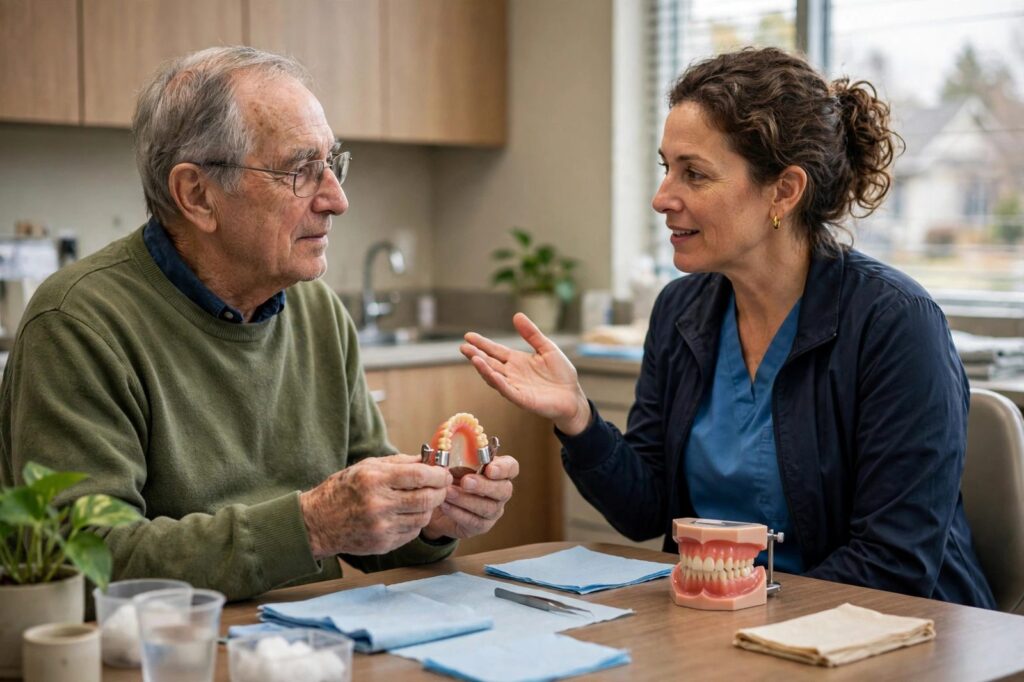
The choice of full vs partial dentures in Thornhill is mostly made by your mouth, not by preference: it depends on how many teeth you have lost and how healthy the remaining ones are. This guide from Emergency Dental Office explains both, honestly — including when keeping your remaining teeth is the smarter plan and when it is not. It supports our dentures in Thornhill page. If you are here because a tooth has just broken or been lost, call us first at (905) 764-5399 and read second.
- What each option is
- Side-by-side comparison
- How to choose
- Factors that affect cost
- FAQs
- Sources and further reading
What each option is
A full (complete) denture replaces every tooth in one arch — upper, lower, or both — and rests entirely on the gums. A partial denture replaces some teeth and holds on to the healthy teeth that remain, usually with small clasps, so those natural teeth share the work. The difference that matters most is this: every healthy natural tooth you keep preserves jawbone, bite strength and options for the future. A partial denture is built around keeping them; a full denture is the answer when keeping them is no longer realistic.
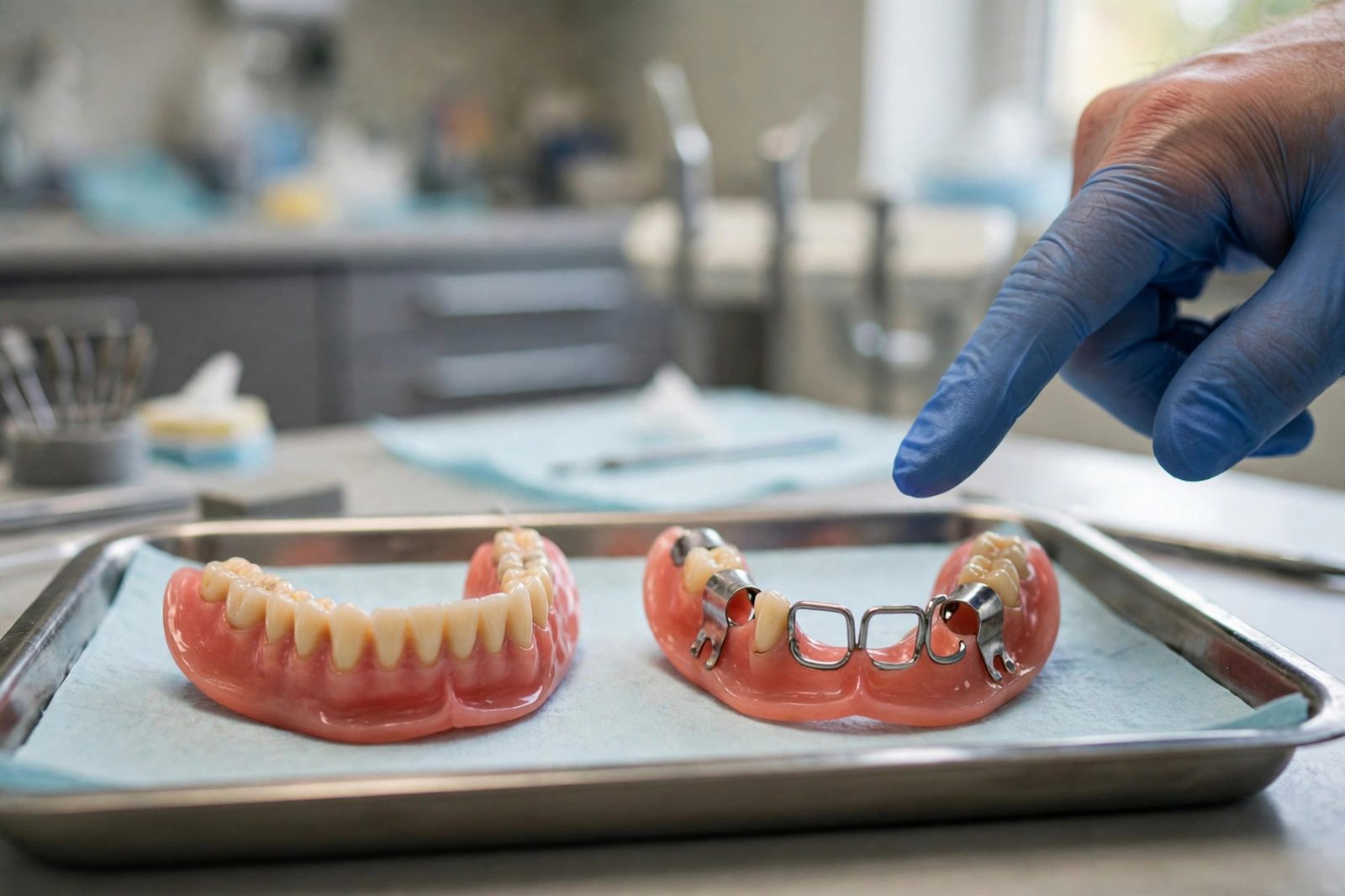
Side-by-side comparison: full vs partial dentures
| Question | Full denture | Partial denture |
|---|---|---|
| What it is / how it works | A complete removable plate of artificial teeth for an arch with no natural teeth left, held by fit and suction against the gums. | A removable plate carrying the missing teeth, clipped to neighbouring natural teeth with clasps; your own teeth anchor and support it. |
| Typical lifespan | There is no fixed lifespan figure in the literature; the Canadian Dental Association notes dentures typically need relining or replacement over the years as the jaw changes shape. Fit decides the timing. | The same applies — the plate itself can serve for years, but its fit changes as the mouth changes, and the health of the teeth it clips to decides its real working life. A partial denture must be remade or adjusted if an anchor tooth is later lost. |
| Maintenance and care | Remove and brush daily, soak as directed, and clean the gums. Looseness that suddenly needs much more adhesive is a sign to book a visit, not to add more adhesive. | Remove and brush daily, and clean carefully around the clasped teeth — food and plaque collect there, and those anchor teeth are doing double duty, so their hygiene protects the whole appliance. |
| Effect on neighbouring teeth and jawbone | With no roots left, the jawbone under the denture gradually shrinks, loosening fit over the years. There are no neighbouring teeth to affect. | Remaining roots keep the jawbone loaded and healthier in those spots. The trade-off: clasps put extra stress on the anchor teeth, which must be strong enough for the role — a weak anchor makes a poor partial denture. |
| Who it suits and who it does not | Suits patients who have lost all teeth in an arch, or whose remaining teeth are too decayed, loose or broken down to keep predictably. It does not suit keeping teeth that could have served for years — that decision is one-way. | Suits patients missing several teeth who still have healthy, well-spaced natural teeth to anchor to. It does not suit mouths where the remaining teeth are themselves failing — building a partial on failing anchors usually means remaking it soon. |
| Number of visits and timeline | A series of visits over a few weeks for impressions, try-ins and fitting. If teeth must be removed first, an immediate denture can be fitted the same day as the extractions, then relined as you heal. | Also a series of visits over a few weeks. Any fillings or treatment the anchor teeth need come first, so the partial is built on a stable foundation. |
| CDCP coverage | Complete dentures may be covered under the CDCP for eligible patients, subject to plan rules. Eligibility comes first, and coverage is never 100% of every fee. | Partial dentures may likewise be covered under the CDCP for eligible patients, subject to plan rules and frequency limits. |
How to choose
Start with an honest census of the remaining teeth: which are healthy, which are repairable, and which are only being kept out of reluctance. Keeping several sound teeth and building a partial denture around them usually gives a stronger bite and better bone preservation than clearing them. Keeping teeth that are loose, deeply decayed or repeatedly infected gives the opposite — a partial built on sand. Sometimes the right plan is staged: a partial denture now, designed so it can be extended if another tooth is lost later. As Thornhill’s emergency office, our homepage remains the home of urgent care — if your visit starts as an emergency, we stabilize the problem first and plan dentures on a healed, honest foundation.
Factors that affect cost
We do not publish prices, because the figure depends on how many teeth are replaced, whether extractions or repairs to anchor teeth are needed, and the materials and clasp design chosen. You receive an exact written quote after examination, before treatment begins. Call Emergency Dental Office in Thornhill at (905) 764-5399.
Frequently asked questions
Is a partial denture better than a full denture?
When the remaining teeth are healthy, usually yes — your own teeth preserve bone, anchor the appliance and give a stronger bite. When the remaining teeth are failing, a full denture on a healed foundation is the more honest plan. The condition of your teeth, not the appliance, decides.
Can teeth be added to a partial denture later?
Often yes. If another tooth is lost, a tooth can frequently be added to an existing partial denture, especially if that possibility was planned for. It depends on the framework and the new gap’s position — bring the denture to your appointment and we will assess it.
How long does it take to get used to dentures?
Most people need a few weeks. Eating starts with soft foods cut small; speech normalizes with practice (reading aloud helps); sore spots in the first days are adjusted at a follow-up visit. Lower full dentures take the most patience because they have the least suction.
Do dentures hurt to wear?
A well-fitted denture should not hurt, though new dentures commonly create a few sore spots that we adjust. We will not promise a pain-free start — an adjustment period is normal — but persistent pain means the fit needs attention, not endurance.
Can I sleep in my dentures?
We recommend removing them at night. Your gums need rest, and nightly removal is when the denture is cleaned and soaked. Sleeping in dentures raises the risk of gum infection and irritation.
Are full or partial dentures covered by the CDCP?
Both may be covered for eligible patients under Canadian Dental Care Plan rules, subject to frequency limits and plan terms. Eligibility comes first, and coverage is never 100% of every fee. Bring your CDCP information and we will explain what applies to you before you commit.
What if my remaining teeth are borderline?
Borderline teeth get an individual verdict based on bone support, decay and how they have behaved over time. Sometimes a tooth is worth one well-planned repair; sometimes keeping it only guarantees an emergency later. We will show you the X-ray evidence behind each recommendation.
Can a denture be anchored on implants instead?
Yes — implants can anchor a full denture so it clicks firmly into place, and this is often the lasting answer for a loose lower denture. Implants themselves are not covered by the CDCP. If you are interested, we will assess your bone and explain the staged plan honestly.
Sources and further reading
- Canadian Dental Association (CDA) — patient guidance on dental treatments.
- Ontario Dental Association (ODA) — patient resources for Ontario.
- Canadian Dental Care Plan — Canada.ca — official coverage information.