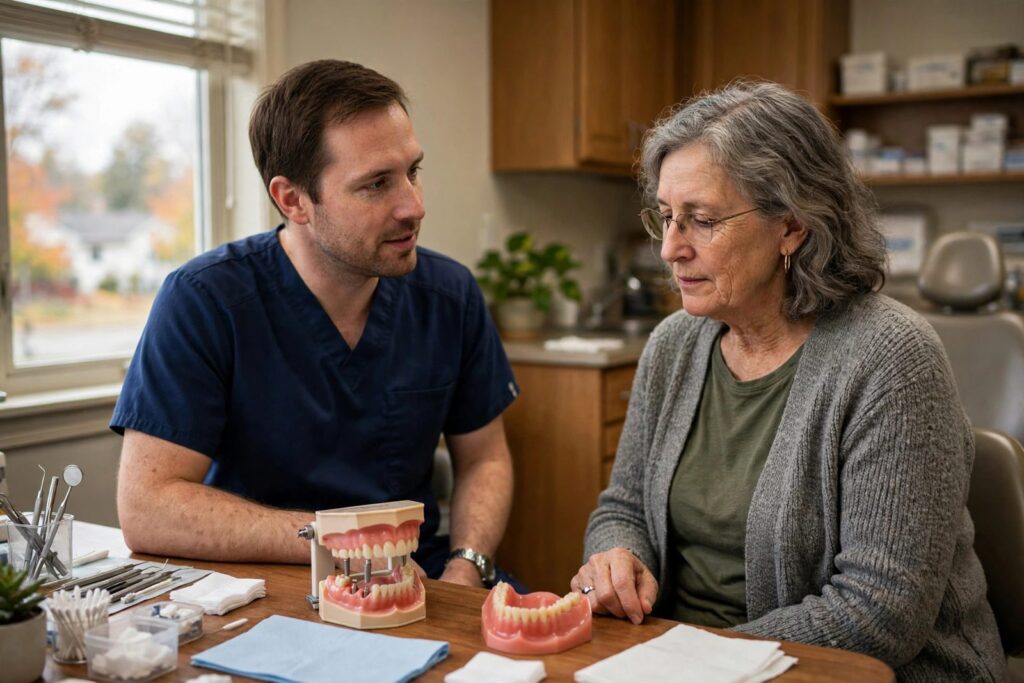
Missing several teeth, or facing the loss of the teeth you have left? Comparing dental implants vs dentures in Thornhill usually comes down to how you want to eat, speak and care for your replacement teeth day to day. This guide compares a removable denture with implant-based replacement — including implant-supported dentures — so you can understand how each works, how long each is reported to last, and who each option does and does not suit before your assessment.
On this page
- What each option is
- Dental implants vs dentures: side-by-side comparison
- How to choose
- Frequently Asked Questions
What each option is
A traditional denture is a removable set of replacement teeth that rests on the gums. A full denture replaces all teeth in an arch; a partial denture replaces some teeth and clips around remaining natural teeth. Dental implants are titanium posts placed in the jawbone that can support individual crowns, a bridge, or a denture that clips or attaches onto them for greater stability. You can learn more on our dental implants service page in Thornhill. General dentistry information for patients is also available from the Canadian Dental Association.
Neither option is right for everyone. Gum and bone health, medical history, dexterity for cleaning, and whether you can attend several appointments over a longer period all affect which options are realistic in your case.
Dental implants vs dentures: side-by-side comparison
| Factor | Traditional removable dentures | Dental implants (including implant-supported dentures) |
|---|---|---|
| What it is / how it works | A removable appliance with replacement teeth on a gum-coloured base. It rests on the gums and, for a lower denture in particular, relies on fit, saliva and muscle control to stay in place. Partial dentures also use clasps around natural teeth. | Titanium posts are placed in the jawbone and integrate with the bone. They can support single crowns, a fixed bridge, or a denture that attaches to the implants and can still be removed for cleaning, depending on the design chosen. |
| Typical lifespan | Dentures gradually lose fit as the jawbone and gums change shape, and they commonly need relining, adjustment or eventual replacement over time. Rather than a single reliable survival figure, the literature focuses on this ongoing need for maintenance and remaking as the mouth changes (see Goodacre et al., 2003, Journal of Prosthetic Dentistry, on clinical complications with dentures and implant prostheses). | Jung et al. (2012, Clinical Oral Implants Research systematic review) reported implant survival of 97.2% at 5 years and 93.2% at 10 years for implants supporting single crowns. For implant-supported overdentures, survival varies by jaw and number of implants, so your dentist will discuss figures relevant to the specific design proposed for you rather than a single general number. |
| Maintenance and care | Remove and clean daily, brush the gums and any remaining teeth, and soak the denture as instructed. Dentures should not be worn continuously without breaks as advised, and loose or sore dentures need professional adjustment — do not adjust them yourself. | Clean daily around implant crowns or attachments, including under an implant-supported denture and around its clips or bar. Regular professional monitoring is needed because peri-implant inflammation can progress without early symptoms. |
| Effect on neighbouring teeth and jawbone | A partial denture’s clasps place extra load on the natural teeth it grips. A full denture rests on the gum, and the underlying jawbone gradually resorbs over time because no tooth roots or implants are transferring biting forces into it, which changes denture fit. | Implants do not require neighbouring teeth to be reshaped for support. Implants transfer biting forces into the jawbone at their sites, which helps maintain bone stimulation there, although bone changes can still occur around implants over time. |
| Who it suits and who it does not | May suit patients who cannot have surgery, who need a replacement more quickly, or who prefer a non-surgical option. It may not suit patients who struggle with a gag reflex, very dry mouth, or difficulty adapting to a removable appliance. | May suit patients with adequate bone and gum health who want a more stable replacement and can complete a surgical, multi-stage process. It may not suit uncontrolled medical conditions, sites with insufficient bone unless further procedures are accepted, or patients unable to maintain the cleaning routine implants require. |
| Number of visits and treatment timeline | Usually a series of appointments over several weeks for impressions, bite records, try-in and fitting, followed by adjustment visits as you adapt. | Usually several visits over several months: planning, implant placement, a healing period for integration, then fitting of the crowns, bridge or implant-supported denture. Timelines are longer if extractions, healing or bone procedures are needed first. |
| CDCP coverage | Coverage for dentures under the Canadian Dental Care Plan depends on eligibility and preauthorization, and the specific type of denture matters. Confirm your own situation before treatment. | Dental implants are NOT covered by the Canadian Dental Care Plan. Coverage for a denture component, if any, depends on eligibility and preauthorization and should be confirmed in advance. |

Factors that affect cost include the number of implants, whether a fixed or removable implant design is chosen, extractions or bone procedures, laboratory work and the materials used. For that reason, cost is discussed after an in-person assessment rather than quoted in general terms here.
How to choose
Think about three things: stability, surgery and upkeep. A traditional denture avoids surgery and can be made sooner, but it is removable and its fit changes as your mouth changes. Implants involve surgery and a longer timeline, but they anchor the replacement teeth more firmly and help maintain bone stimulation. Some patients start with a denture and consider implants later; others choose an implant-supported denture as a middle path. Your dentist will assess your bone, gums, bite and medical history, explain the limitations of each option in your case, and help you weigh them honestly.
Frequently Asked Questions
Are implant-supported dentures removable?
Most implant-supported dentures are designed to clip on and off the implants so you can remove them for cleaning. Some implant designs are fixed and can only be removed by the dentist. Your dentist will explain which design is being proposed for you.
How many implants are needed to hold a denture?
It depends on the jaw, bone volume and the design. Fewer implants are typically used for a lower denture than for an upper one, but there is no single number that fits every patient — it is decided after imaging and planning.
Will a denture affect how I speak or eat?
There is usually an adjustment period. Speaking and chewing often improve with practice and with adjustments at follow-up visits, but a removable denture will not feel identical to natural teeth, and very hard or sticky foods can remain difficult.
Can implants fail?
Yes. An implant may not integrate, or peri-implant disease may develop later. Smoking, uncontrolled diabetes and inadequate cleaning increase risk. Your dentist will discuss your individual risk factors before treatment.
What if I do not have enough bone for implants?
Options may include a different implant position or design, or a bone procedure, or staying with a traditional denture. Each carries its own limitations and healing time, and your dentist will explain what imaging shows in your case.
Can my current denture be converted to attach to implants?
Sometimes an existing denture can be adapted, and sometimes a new denture needs to be made to fit the implant attachments correctly. This is assessed by examining your current denture and planning the implant positions.
Does the CDCP cover implants or dentures?
Dental implants are not covered by the Canadian Dental Care Plan. Denture coverage depends on eligibility and preauthorization. The clinic team can help you understand what to confirm before you commit to a plan.
How soon can I get a denture after extractions?
An immediate denture can sometimes be made to be fitted on the day teeth are removed, with the understanding that it will need adjustments and relining as healing changes the shape of the gums. In other cases, healing first and then making the denture gives a better initial fit. Your dentist will advise which applies to you.
Weighing implants against dentures? Book an assessment at Emergency Dental Office in Thornhill by calling (905) 764-5399. The team will examine your teeth, gums and bone, explain your options and their limitations, and help you choose a plan that fits your health and your daily life.