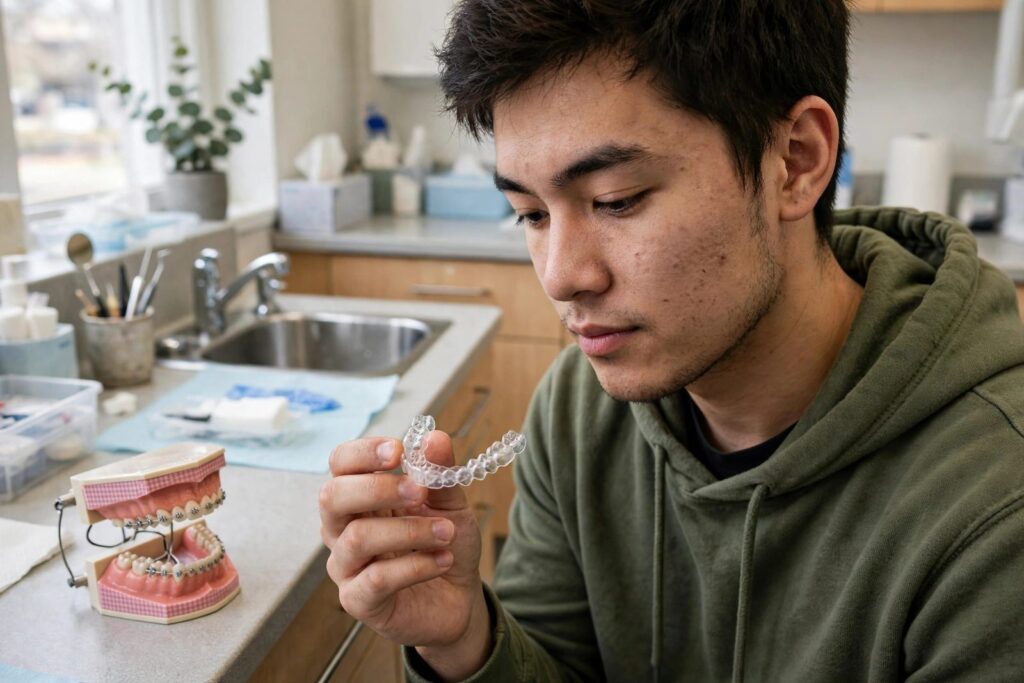
The choice of braces vs clear aligners in Thornhill isn’t really about looks — it’s about how much tooth movement your case needs, and how reliably the treatment will be worn. Braces move teeth with brackets and wires that work around the clock. Clear aligners move teeth with a series of removable trays that only work when they’re actually in your mouth. This guide compares them honestly, including who each one does not suit.
Orthodontic treatment sits within our broader care — see our page on general dentistry services in Thornhill at Emergency Dental Office for how assessment and routine care work here. And a note on roles: our homepage is where urgent care lives — this guide supports it, and if you’re in pain right now, skip the reading and call (905) 764-5399.
On this page
The short answer
Complex movements — big rotations, teeth that need to move vertically, significant bite correction — are still braces’ home ground. Mild to moderate crowding or spacing in a motivated adult or older teen is where aligners shine. The honest deciding factor is often compliance: aligners need 20–22 hours of wear a day, every day, and a treatment worn half-time delivers half a result.
Braces vs clear aligners, side by side
| Braces (fixed appliances) | Clear aligners | |
|---|---|---|
| What it is / how it works | Brackets are bonded to the teeth and connected by a wire that’s adjusted over time, applying continuous force in three dimensions — including rotations and vertical movements that are hard to achieve any other way. | A series of custom transparent trays, each worn for one to two weeks, nudging teeth in small planned steps. Small tooth-coloured attachments are often bonded to teeth to give the trays grip. |
| Typical lifespan | Orthodontic results don’t carry a “lifespan” the way a crown does — the relevant evidence is about outcomes and retention. Papageorgiou et al. (2020), a systematic review and meta-analysis in the Journal of Dentistry comparing clear aligners with fixed appliances, found both achieved comparable occlusal outcomes in suitable cases, with some evidence of shorter treatment duration for aligners in mild-to-moderate cases. Rossini et al. (2015), a systematic review in the Angle Orthodontist, found aligner tooth movement was least predictable for rotations and vertical movements. Either way, results last only as long as retainers are worn — teeth drift without them, whatever moved them. | |
| Maintenance and care | Brushing and flossing take longer and need extra tools (floss threaders, interdental brushes). Some foods are off the table — hard, sticky, chewy — and broken brackets need repair visits. | Trays come out for eating and cleaning, so hygiene is simpler — but trays themselves need daily cleaning, teeth should be brushed before trays go back in, and trays left in a napkin have a way of ending up in the bin. |
| Effect on neighbouring teeth and jawbone | Orthodontics moves teeth through the jawbone — bone remodels around moving roots, which is the whole mechanism. Well-aligned teeth are easier to clean, which helps gums long-term. Roots can shorten slightly (resorption) during any orthodontic treatment; this is monitored with imaging. | The same bone-remodelling mechanism and the same root-resorption monitoring apply. Aligner treatment plans sometimes include small amounts of interproximal reduction (polishing tiny amounts of enamel between teeth) to create space — your dentist will flag this if your plan needs it. |
| Who it suits and who it does not | Suits complex cases, younger teens, and anyone who knows wear-discipline would slip. Less suitable if you strongly object to visible appliances or play contact sports without a proper guard plan. | Suits mild-to-moderate crowding and spacing, adults and responsible older teens, and people who need removability for work or events. Less suitable for complex rotations or bite problems, and for anyone honest enough to admit the trays would live in their pocket. |
| Number of visits and timeline | Adjustment visits roughly every 6–8 weeks; total treatment commonly runs 18–30 months depending on complexity. | Check-ins roughly every 6–10 weeks, sometimes with several tray sets dispensed at once; mild-to-moderate cases commonly run 6–18 months. Refinement rounds (extra trays) are a normal part of many plans, not a failure. |
| CDCP coverage | Orthodontic treatment under the Canadian Dental Care Plan sits under separate, narrow criteria and most routine braces or aligner treatment is not covered — the plan is designed around medically necessary care for eligible patients. Eligibility always comes first, and we’ll check your situation honestly rather than assume. Federal details: Canada.ca — Canadian Dental Care Plan. | |

How to choose
Complexity first, lifestyle second, vanity a distant third — that’s the order that produces good outcomes. If your case needs movements aligners do unpredictably, braces aren’t the old-fashioned option; they’re the correct one. If your case is mild and your routine is disciplined, aligners are a genuinely comfortable way to get there. Factors that affect cost include case complexity, treatment length, and whether refinements or repairs are needed, so an exact figure follows an assessment. Call Emergency Dental Office in Thornhill at (905) 764-5399 to book one.
Common questions
Are clear aligners faster than braces?
Sometimes, in mild-to-moderate cases — the Papageorgiou et al. (2020) systematic review found some evidence of shorter duration there. In complex cases braces are often faster in practice because they don’t depend on wear time and can make movements aligners struggle with.
Do aligners hurt less than braces?
Both cause pressure and tenderness when teeth start moving — that’s how orthodontics works. Aligner discomfort typically peaks in the first days of a new tray; braces discomfort peaks after adjustments and can include sore cheeks from brackets early on. Neither should cause sharp, escalating pain — call us if it does.
Can I switch from braces to aligners mid-treatment?
Sometimes, once the heavy movements are done — but switching means new records, new planning, and new costs. It’s a conversation to have at your assessment, not a fallback to count on.
What happens if I lose an aligner tray?
Call us promptly. Depending on where you are in the sequence, you’ll be told to move to the next tray early or go back to the previous one while a replacement is ordered. Don’t just skip ahead on your own — fit matters.
Do I really need a retainer afterwards?
Yes — with either treatment. Teeth have memory and drift back, especially in the first year. Retainer wear is the difference between a result that lasts and a result that slowly unravels.
Can teens use clear aligners?
Older teens often can, and aligner systems include compliance indicators for exactly this question. The honest test is the teen, not the birthday: trays worn at school, at practice, and at friends’ houses — or not.
Will braces or aligners fix my bite, or just straighten teeth?
Both are bite treatments, not just cosmetic ones — correcting how teeth meet affects chewing, wear, and jaw comfort. Significant jaw discrepancies in growing patients, or severe adult bite problems, may need approaches beyond either option, and we’ll say so if that’s your case.
I have a toothache and I’m mid-treatment. What do I do?
Call us at (905) 764-5399. New or escalating pain during orthodontic treatment needs checking — it can signal a problem with a tooth rather than normal treatment pressure, and urgent problems are what our Thornhill clinic is built around.
Emergency Dental Office, Thornhill — (905) 764-5399.