
On this page
The short answer
A missing tooth leaves two classic ways to fill the gap: a dental implant vs fixed bridge decision. An implant stands on its own — a post in the bone with a crown on top. A fixed bridge is held by crowns on the teeth on either side of the gap. Both can look and chew like a natural tooth. They differ in what they ask of your other teeth, your bone, and your calendar. This guide compares them for patients in Thornhill.
Emergency Dental Office’s homepage is where urgent care starts; for replacement planning, see dental implants in Thornhill.
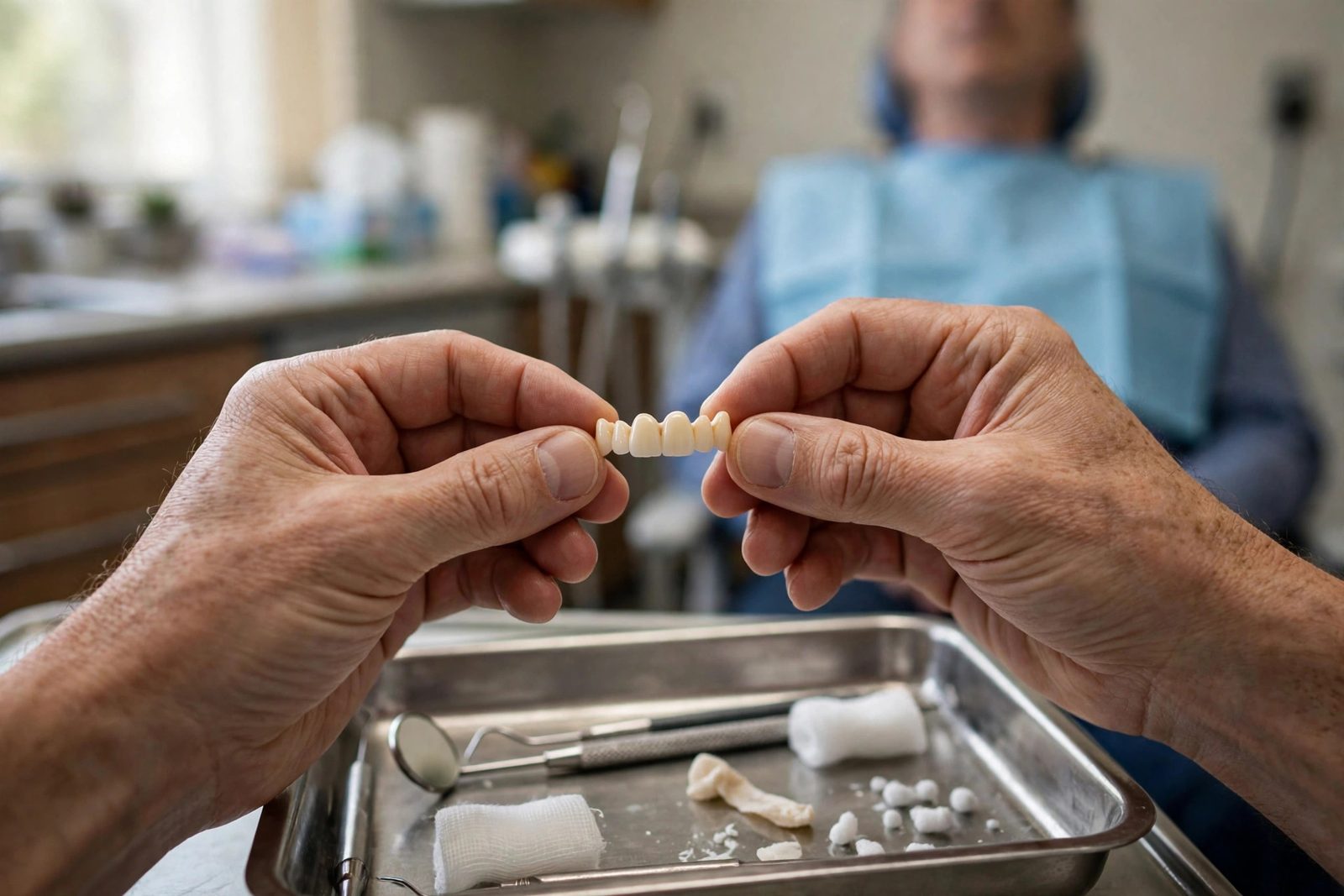
Dental implant vs fixed bridge, side by side
| Dental implant | Fixed bridge | |
|---|---|---|
| What it is / how it works | A titanium post placed in the jawbone where the root was; after healing, a single crown is attached. It replaces the tooth without involving its neighbours. | One or more false teeth held in place by crowns cemented onto the natural teeth on each side of the gap, which are shaped to receive them. |
| Typical lifespan | Systematic reviews by Pjetursson and colleagues report 10-year survival around 95% for single implants (survival of the implant/restoration, not a guarantee for an individual). | The same review literature reports 10-year survival around 89% for tooth-supported fixed bridges. When a bridge fails, it is often because one of its supporting teeth develops decay or needs a root canal. |
| Maintenance and care | Brush and clean around it like a natural tooth, including at the gumline; check-ups and periodic X-rays monitor the bone. | The false tooth sits on the gum, so you clean under it with floss threaders or interdental brushes — an extra step that matters, because the supporting teeth can decay at the crown edges. |
| Effect on neighbouring teeth and jawbone | Neighbours are untouched. The post loads the bone in the gap, helping limit the shrinkage that follows tooth loss. | The two neighbouring teeth are ground down to hold the crowns, even if they were perfectly healthy. The bone under the false tooth gets no root stimulation and gradually shrinks. |
| Who it suits — and who it does not | Suits a gap with healthy neighbours and enough bone (or bone that can be rebuilt), in a patient whose health allows a minor surgical procedure. Heavy smoking and some uncontrolled conditions argue for caution. | Suits a patient who wants a faster, non-surgical result, or where the neighbouring teeth already need crowns of their own — then the bridge solves two problems at once. It is a poorer choice when the neighbours are untouched and healthy. |
| Number of visits and timeline | Several stages over a few months: placement, healing while the post integrates, then the final crown. | Usually two to three visits over a few weeks, with no surgical healing period. |
| CDCP coverage | Dental implants are not covered by the Canadian Dental Care Plan. | Fixed bridges are not covered by the Canadian Dental Care Plan. |
How to choose
Look at the teeth beside the gap. If they are healthy and untouched, most dentists lean implant, because a bridge would permanently reshape them. If those teeth already need crowns, a bridge can be the practical answer — and it is finished in weeks rather than months. Cost depends on the number of teeth involved, whether grafting is needed, and materials, so we give an exact written quote after an examination rather than figures in an article.
If the gap came from an emergency — a broken or knocked-out tooth — call Emergency Dental Office in Thornhill at (905) 764-5399 first; urgent problems are dealt with before replacement planning. General references: the Ontario Dental Association and the federal CDCP page.
Common questions
Which looks more natural, an implant or a bridge?
Both can look very natural. An implant crown emerges from the gum like its own tooth, which can help at the front of the mouth. A well-made bridge blends in too — the difference is more about the supporting teeth than the appearance.
Can a bridge replace two missing teeth?
Sometimes, if the supporting teeth are strong enough. Longer spans put more load on the supports, so beyond a certain length implants are usually the more predictable plan. This is decided from your X-rays.
What if one of the bridge’s supporting teeth fails later?
Because the bridge is one connected piece, a problem with a supporting tooth usually means remaking the whole bridge — or converting the plan to implants at that point.
Is implant placement painful?
The area is fully frozen during placement and most patients manage the following days with ordinary pain relief. We will not promise a pain-free experience; soreness varies by case.
How soon after an extraction can I get an implant or a bridge?
A bridge can often be planned once the gum has healed, within weeks. An implant sometimes goes in the same day as the extraction and sometimes after a healing period — it depends on infection and bone, assessed case by case.
Does the CDCP cover either option?
No. Neither dental implants nor fixed bridges are covered by the Canadian Dental Care Plan. Other services, such as the extraction itself or a denture, may be covered for eligible patients.
Which is easier to clean?
An implant crown cleans much like a natural tooth. A bridge needs an extra step — threading floss or a small brush under the false tooth daily — because food and plaque collect where it meets the gum.
What if I do nothing about the gap?
A back-tooth gap is sometimes monitored rather than filled. But teeth beside and opposite a gap tend to drift over time, and the bone shrinks, which can narrow your options later. Ask us to show you what is likely in your case.